
Waking up with a red, sticky eye can be alarming. Is it an infection? Is it contagious? Often, patients confuse a flare-up of blepharitis with "pink eye" (conjunctivitis). Differentiating them is vital because antibiotics for pink eye will not fix chronic blepharitis.
Explore the full overview: See the Blepharitis symptoms and diagnosis hub for related guides.
1. The Duration (Time Is Key)
The biggest clue is how long it lasts.
- Pink Eye (Conjunctivitis): Usually acute. It comes on suddenly, gets worse over a few days, and typically resolves (with or without treatment) in 1 to 2 weeks.
- Blepharitis: Usually chronic. You have probably had low-grade symptoms for months or years, with periods where it gets slightly better or worse. It rarely "just goes away" on its own.
2. The Discharge
What is coming out of your eye?
Pink Eye
- Viral: Watery, tearing discharge. Often starts in one eye and spreads to the other.
- Bacterial: Thick, yellow-green pus (mucopurulent). The eye is "glued shut" with goop in the morning.
Blepharitis
- Crusts/Flakes: Hard, dry crusts "like cornflakes" or dandruff at the base of the lashes.
- Foam: Foamy tears can occur with meibomian dysfunction; the mechanism is not fully established.
- It is rarely "goopy" in the same way an active infection is.
3. The Location of Redness
Look closely in the mirror.
- Pink Eye: The white of the eye (sclera) is bright pink or red. The inner eyelids are very red.
- Blepharitis: The eyelid margins (the rim where lashes grow) are red, thickened, and swollen. The white of the eye might be slightly red, but the "action" is on the eyelid rim.
4. Is it Contagious?
Some forms of conjunctivitis (viral/bacterial) are contagious; others (allergic/irritant) are not. Because symptoms overlap with blepharitis and dry eye, seek assessment if you have significant discharge, one-sided onset, contact lens wear, pain, light sensitivity, or vision change.
Blepharitis: Blepharitis itself is usually not contagious. Good hygiene (not sharing towels/makeup) is still sensible, especially if there's discharge or a suspected infection.
Summary Table
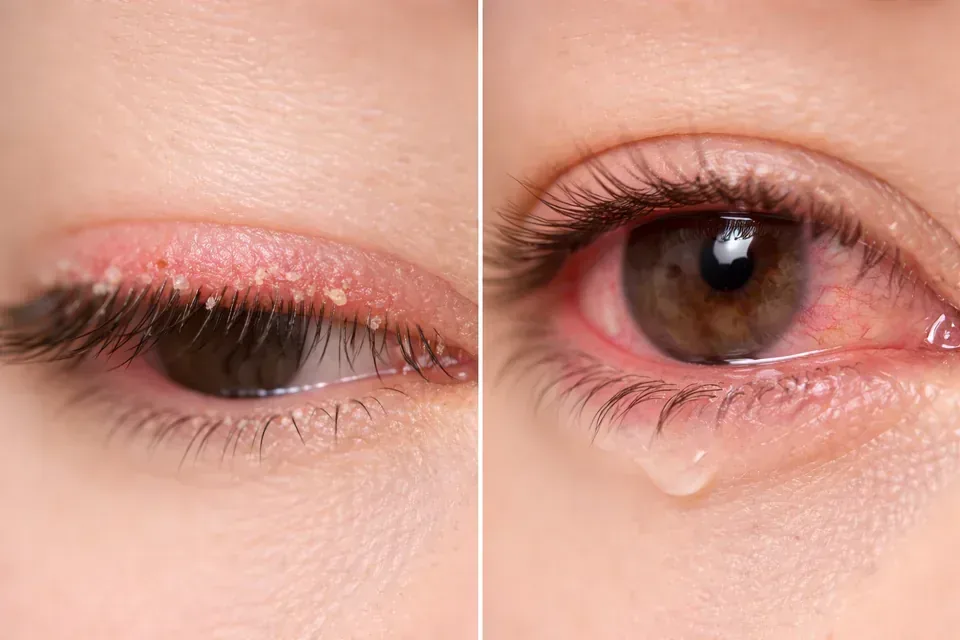
Visual comparison of blepharitis versus pink eye.
| Feature | Blepharitis | Pink Eye (Infective) |
|---|---|---|
| Duration | Chronic (Months/Years) | Acute (Days/Weeks) |
| Main Symptom | Itching, Grittiness, Dryness | Discharge, Matting, Tearing |
| Lashes | Crusty, Dandruff | Matted with Pus |
| Contagious? | No | Depends on cause |